How To Get Clarity?
Discover how to get clarity. Explore topics of rapid prototyping, a decision-making framework, and practical moves to help you achieve clarity of mind. Enjoy.
Table of Contents
- Introduction
- Mental Clarity Is Built, Not Found
- Mindfulness Sharpens the Lens
- Rapid Prototyping
- Reduce Noise to Raise Signal
- Decision-Making Framework: Clarity Guide
- Conclusion
- FAQ
- Support Us
- Author Bio & Social
Introduction
Clarity doesn’t arrive by accident. It is shaped. It is earned. Clarity is the child of careful thought and mindful experimentation—the steady practice of focused thinking, then testing small to learn fast. When we reduce mental noise, focus our attention, and turn questions into mindful experimentation, confusion becomes data and data becomes direction. In this guide, we’ll blend science, rapid prototyping, and practical moves to show you how to create clarity of mind on demand. You’ll learn a repeatable protocol, see why mindfulness boosts working memory, and discover how simple test-and-learn cycles transform fog into forward motion.
Mental Clarity Is Built, Not Found
Mental clarity begins with how we think. When the mind is overloaded, even good intentions blur. Working memory is limited; when we remove clutter and structure thinking, problem-solving improves. That’s why a messy to-do list, scattered documents, and constant pings sabotage clear decisions—your mental bandwidth is already full. Streamlining inputs (one inbox, one plan, one next action) frees the space needed to see patterns and choose wisely. Clarity is not a lightning bolt; it’s the result of a focused thinking that favors depth over distraction.
Practical moves:
- Consolidate tasks into one list.
- Simplify a list of complex tasks into an umbrella goal(a single sentence that covers all tasks). This remedies cognitive dissonance and streamlines focus into one goal.
- Decide on the single most vital priority for today.
Mindfulness Sharpens the Lens
Your power to direct your attention directly impacts your level of clarity. Mindfulness training improves working memory, increases recall ability, and reduces distracting thoughts, which supports complex reasoning and better choices. A mindful mind is vigilant and aware of the bigger picture which processes information better.
Sleep also matters: even partial sleep deprivation impairs attention and cognitive function, clouding judgment and learning. If your mental lens is fogged by fatigue, the sharpest strategy won’t help. Protecting and enhancing your sleep will multiply the effectiveness of your mental faculties of perception, will, imagination, memory, intuition, and reasoning.
Practical moves:
- Take a minute to focus on your breath.
- Take a walk in nature.
- Body scan from head to toes; become aware of sensations without judging.
- Commit to a consistent daily sleep schedule
- Invest in your favorite memory foam pillow, high quality mattress, and the most comfortable covers & blankets you can find.
Rapid Prototyping
When you can’t see the path, build it with small tests. In business and in life, mindful experiments and rapid prototypes convert opinions into evidence – data into well informed decisions. Cultures that normalize testing consistently learn faster and make better decisions.
The principle applies to your life: instead of debating the “perfect” workout, morning routine, or business idea, why not ship a low-risk test, read the signal, and iterate. Our cornerstone philosophy – Kaizen which is “constant-never ending improvement” reinforces this: perform mindful experimentation to discover what is true and false, at the minimum to collect data that helps you increase the chances of making a correct decision. Rapid prototyping is the act of creating real-life working models so that we can acquire real-life data vs making assumptions from intangible theory models. Once working model also known as prototype has been created, we can improve upon it which brings to surface valuable data that helps us to reduce risk long before making big commitments.
Practical moves:
- Define a decision you’re stuck on.
- Draft two versions, test for a short period, measure the result.
- Keep what works, discard what doesn’t—no drama, just data.
When performing mindful experimentation, keep in mind the advice of reverend Michael Beckwith – “It is what it is, accept reality. Harvest the good. And forgive the rest.”
Reduce Noise to Raise Signal
Two forces blur clarity: task switching and excess input.
- Task switching: When you jump from one task to another without fully closing the first, a residue of attention lingers, frenetic energy in the mind increases, and harms performance. Single-tasking wins meaning we should avoid multi-tasking. Batch shallow work. End tasks with a closure note so your mind can release them. This performance secret is called “Box & Shelf.” An example of this performance secret in action is putting all documents into a single manilla folder, labeling it, and writing a quick closure note to help you continue to later where you left off, then box & shelf that manilla folder for easy access next session.
- Sleep debt and overload: Even modest sleep loss degrades attention and working memory. Protect your cognitive bandwidth the way a pilot protects fuel.
- Reflect Often: Reflecting on past experiences improves clarity, helps process emotions, and establishes wisdom. This is similar to evaluating data collected from a mindful experimentation and creating well-informed conclusions. These conclusions establish wisdom.
Practical moves:
- Set a 60-minute deep-work timer.
- Mute notifications. Activate your Do-Not-Disturb function on all devices.
- Use a planner and schedule block times for your deep-work.
- At the end of day, take a moment to reflect on how your day went
Decision-Making Framework: Clarity Guide
- Establish your Values & Principles: These are your guardrails of life
- Decision Processing Flow: Does your decision conflict with your values and principles? If yes, do-not move forward with that decision. If no, then move forward.
- Optional: Still unconfident of making your decision? Create a mindful experimentation with little risk. Then evaluate results, weighing your risks vs rewards. Do you like the results of your mindful experimentation? Then apply Kaizen and continue to iterate until you have enough confidence to make a true decision.
Rule Of Engagement: God did not put us on this earth to make right decisions. He put us on this earth to make decisions, then it is up to us to make that decision right.
Conclusion
When life feels foggy, stop hunting for certainty and start building clarity. Clarity is the child of careful thought and mindful experimentation—of a quiet mind, a focused plan, and small tests that turn guesses into guidance. Protect your attention. Sleep like your future depends on it. Test to learn what is true. And reflect often to turn your experiences into your wisdom. May your steps be steady, your learning fast, and your path brightened by the truth that helps you become better.
FAQ
Q1: How often should I run experiments on a personal goal?
Weekly is excellent. Keep tests tiny and track one metric so you learn fast without overwhelm.
Q2: Isn’t mindfulness just relaxing?
Mindfulness is active attention training. It improves working memory and reduces mind-wandering—both essential for clear thinking.
Q3: If I’m exhausted, can I still get clear?
Only partially. Sleep loss and fatigue impairs attention and cognitive function; prioritize rest & recovery to restore clarity.
Q4: I multitask well—do I really need single-tasking?
Yes. Research shows performance drops when switching tasks. Closing one task before the next helps clarity.
Q5: How do I handle fear of being wrong?
You have the power of will to focus on being right or being wrong. I recommend focus on being right. Expect the best things in life and always be prepared for the worst case scenarios.
Support Us
If today’s lesson helped you, join our Lion Wisdom Daily program for more powerful daily teachings—and explore our Performance Trigger Collection to keep you focused and inspired in your environment. Your support fuels new lessons for the world. 
Author Bio & Social
Lion Mentor is the voice of 808 Lion Lifestyle—uniting faith, wisdom, and evidence-based practice to empower your best life, just one day at a time. Follow us on social: Facebook | Instagram | X/Twitter | LinkedIn | TikTok
Recommended Products

What Is Clarity T-Shirt
$19.99
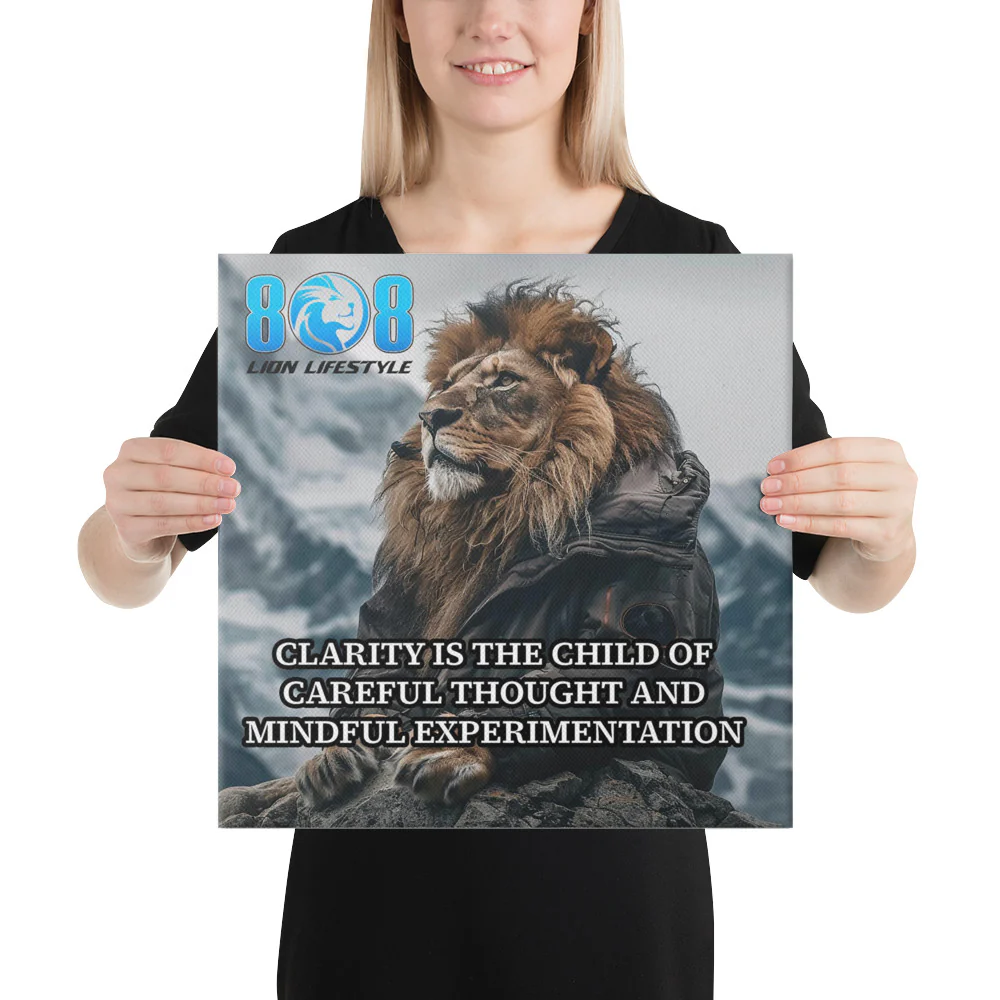
What Is Clarity Canvas
$55.55

What Is Clarity Sticker
$6.95